The Schuylkill River Trail Has a New Bridge and it Moves. Here’s Why That’s a Big Deal.
Authored By: The Circuit Trails | November 12, 2026
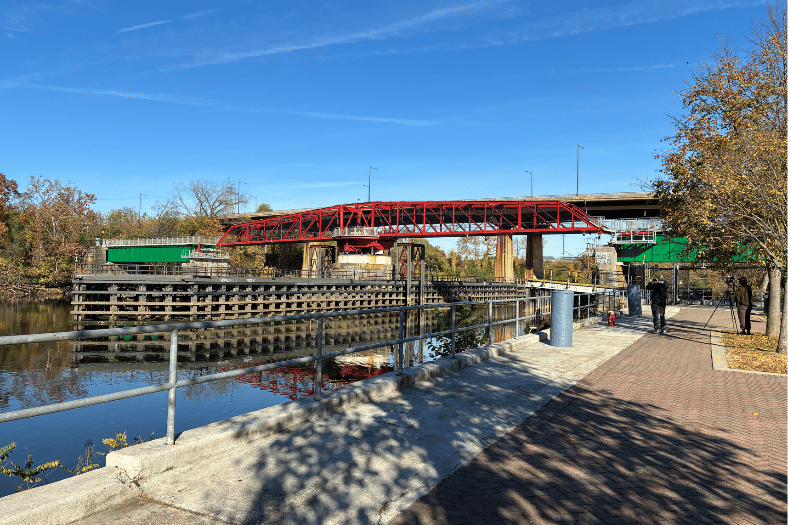
Philadelphia just completed a bridge along the Schuylkill River Trail that swings open to let boats pass through the river. It’s a pretty cool engineering feat, and certainly not something you see every day.
But the new Schuylkill Crossing Swing Bridge is about much more than a bridge that moves. It’s opening up new ways for people to explore the city, reach destinations, and travel between neighborhoods that have long been separated by the river.
The new trail segment, which includes the swing bridge, officially opens Friday, Nov. 13, and connects Grays Ferry Crescent and Bartram’s Mile, creating a safe, off-road route for people walking, biking and using mobility devices to cross the Schuylkill River. It also extends the Schuylkill River Trail south toward Bartram’s Garden, making it easier for more people to access one of Philadelphia’s most distinctive historic and natural destinations.
And that’s just the beginning.
Bridging Gaps
Before the bridge opened, getting from Southwest Philadelphia to Bartram’s Garden and the surrounding trail network wasn’t easy without a car. People walking or biking had to navigate busy roadways and other barriers, making what should have been a relatively simple trip inconvenient and, in some cases, unsafe.
Now, the bridge creates more than nine continuous miles of trail connecting Southwest Philadelphia, from 61st Street to Ridge Avenue in East Falls.
For people who already use the Schuylkill River Trail, that means more room to ride, walk and explore. For those who live in nearby neighborhoods, it means a new way to reach parks, waterfront destinations and other parts of the city without needing to get behind the wheel.
And for visitors, it opens up another way to experience Philadelphia.
The connection also makes it easier to reach Bartram’s Garden, one of the city’s most remarkable green spaces. Known for its gardens and historic landscape, Bartram’s also offers environmental education resources, community programming, water access and initiatives that support food security. Connecting it more directly to the trail network gives more people an opportunity to experience everything the destination has to offer.
That’s the power of a connected trail network. It’s not just about getting outside. It’s about making more of the places that make a community special accessible to everyone.
Why Connecting the Trail Segments Matters
The Schuylkill Crossing Swing Bridge is one small piece of a much bigger picture.
The Circuit Trails is a growing regional network of trails spanning nine counties across Greater Philadelphia and southern New Jersey. Today, the network includes more than 500 miles of completed or in-progress trails, with a long-term vision of more than 860 miles of interconnected routes.
But building a trail network isn’t just about adding new miles. It’s about connecting the ones that already exist.
Think about it this way: A trail can take you somewhere, but a connected trail network can take you much farther and to more places. Every gap that closes creates new opportunities to reach neighborhoods, parks, schools, businesses, cultural destinations, and other places people want and need to go.
We’ve seen this happen elsewhere along the Schuylkill River Trail. The recently completed 422 connector in Montgomery County linked existing trail segments to create a continuous 70-mile mostly off-road route between Philadelphia and Reading. The new segment added less than a mile, but its impact reached much further.
The Schuylkill Crossing Swing Bridge does the same thing for Philadelphia, turning two previously disconnected trail segments into a more useful, safe and accessible route.
And the benefits aren’t limited to transportation. Safe, connected trails give people more opportunities to explore their surroundings, discover new places, spend time outdoors and connect with their communities. Removing barriers can open the door to experiences that might otherwise feel out of reach.
The Work Behind the Swing
Of course, a bridge like this doesn’t come together overnight.
The vision for a connected trail corridor along the Schuylkill River dates back decades. Schuylkill Banks and its partners have worked for years to create a continuous riverfront trail that brings surrounding communities closer to the water and the many destinations along its banks.
Making the Schuylkill Crossing a reality required years of advocacy, community engagement, planning, fundraising, permitting, engineering and construction. It took public agencies, elected officials, nonprofit organizations, funders, engineers and contractors working together to bring the project across the finish line.
That kind of collaboration is at the heart of the Circuit Trails Coalition, a group of nearly 70 organizations working toward a shared vision for a connected regional trail network.
And the momentum is continuing. The Pennsylvania Department of Conservation and Natural Resources recently awarded more than $3.3 million to six Circuit Trails projects in October as part of the Community Conservation Partnerships Program grants, and that comes on the heels of the $322 million secured in July for Circuit Trails projects from the Delaware Valley Regional Planning Commission as part of the FFY2027 Pennsylvania Transportation Improvement Program (TIP), the largest amount programmed for trail projects in the TIP’s history.
It’s another sign of the growing recognition that trails are more than recreational amenities. They’re important infrastructure that helps communities connect.
Where Can the Circuit Trails Take You Next?
A trip to Bartram’s Garden becomes easier. A ride along the Schuylkill River Trail can go farther. Neighborhoods that once felt disconnected have another way to reach the places around them.
And that’s what the Circuit Trails is all about: creating a network that connects people to places, destinations and one another.